
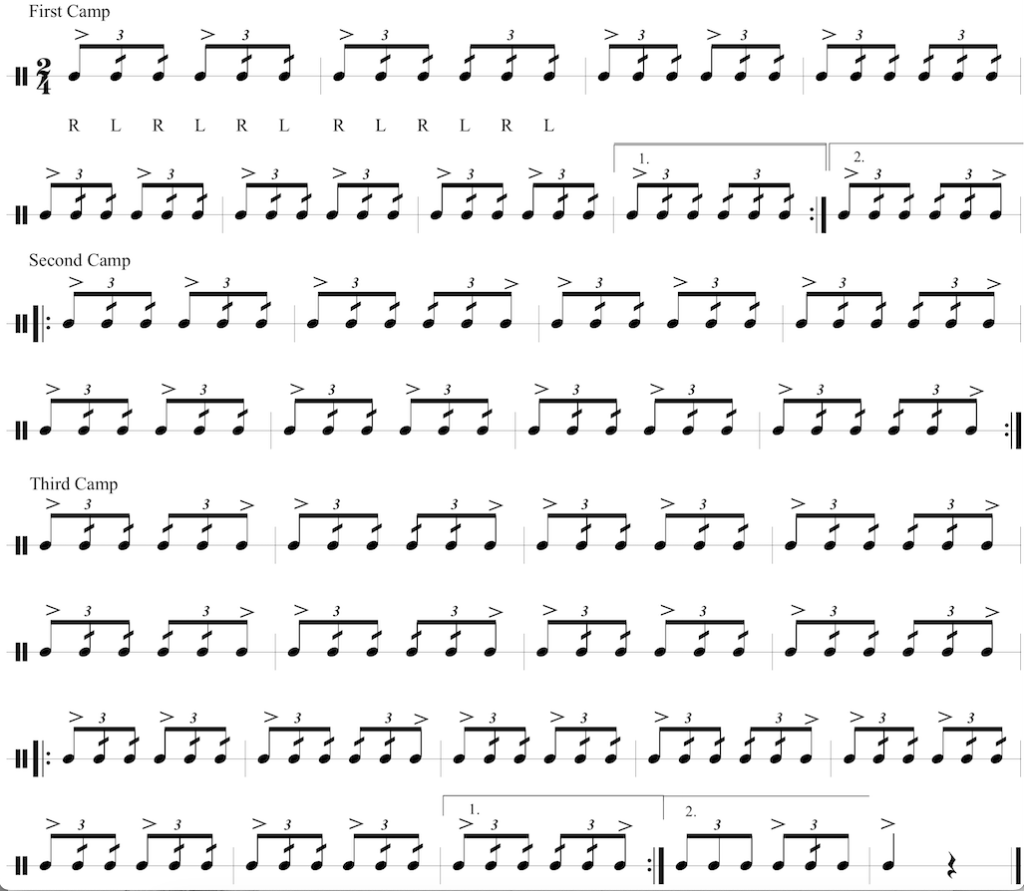
The most commonly known beating from the American Reveille sequence is the “Three Camps,” sometimes called the “Mother and the Three Camps,” or “Points of War.” Fred Johnson, in 2014 for CADRE, compiled a list of at least 20 written examples and three recorded examples of British and American versions of “Three Camps” throughout the ages. He certainly did not list them all. Among them are several variations on the structure or number of beats in the rolls, but they all vaguely conform to a standard pattern — a recognizable sequence of accents arising from an otherwise continuous or near-continuous texture of Open Double Stroke Rolls. The most common variant features 5 Stroke Rolls and 11 Stroke Rolls in the first camp, followed by variations that include 10 Stroke Rolls in the second and third camp, with no rests or breaks between the rolls for the duration. I have notated it below. There are a variety of notation styles for this pattern, and of course some variation on the roll numbers, but this is the gist of the American and British paradigm, in print from 1780 to the present but certainly extending even further back in practice.
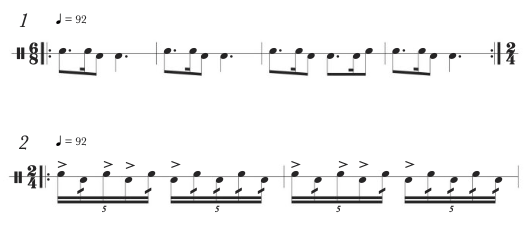
Lesser known to Americans are the various Reveille beatings from the rest of the world that both serve the same basic purpose, a beating to begin the day, and follow the general pattern of a continuous roll with an internal accent pattern. Of course, these various beatings do not all conform to the Anglo-American rhythm. In fact, a much more prominent rhythm is that of the French “La Diane” and/or the Swiss “Tagwacht.” Below is Carnaud’s version from 1870, followed by the official “Schweizer Tagwacht” or “Diane suisse” from the Tambour-Ordonnanz of 1981. The Swiss “Tagwacht” goes back to 1728 in a written form, with a very similar feel, and possibly much further back in practice. This 1981 version is much easier to read than a lot of earlier examples. Similarly, the “Diane” likely predates 1870 by a long time, but Carnaud wrote out every note very clearly in a way that other authors often did not.

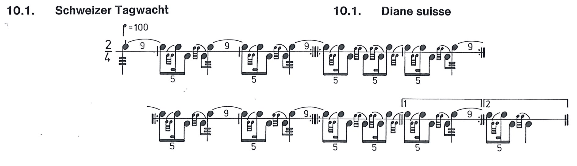
Both the Swiss and French signals here, from 111 years apart, show approximately the same rhythm, despite the difference in notation style and in time signature. Similar to the wide range of notation styles used for the “Three Camps,” the Diane/Tagwacht has historically been notated in several seemingly unrelated ways, but the result is intended to be the same or quite similar. This same beating, or one extremely similar to it, has been used across history in many parts of Europe, though it can be difficult to recognize at times. The notation often makes it difficult to see the relationship, but it is there if you dig deep enough. For example, the 1820 and 1823 Swedish version of this signal looks nothing like either the French or Swiss above, yet it likely has a similar rhythm and roll structure.

The Swedish “Allmán-dd (Reveljslag)” here from 1823 appears to have far fewer rolls than the Swiss “Tagwacht.” Appearances can be deceiving. The accent pattern of the Swiss and French signals is very similar to that of the single notes written out here and, with a little creative thinking, could very strongly resemble the sound of the “Tagwacht/Diane” if rolls were introduced between the single notes that are written. There is actually evidence that Nordic drummers engaged in the practice of adding Open Rolls between written Single Strokes. The modern Swedish military version of this signal, as outlined by Rolf Landberg (2024 The Drumming Traditions of Sweden), uses the quintuplet phrasing of the Swiss “Tagwacht” or French “Diane,” yet still employs the notation is that of the old 19th century Swedish “Reveljslag” signal.
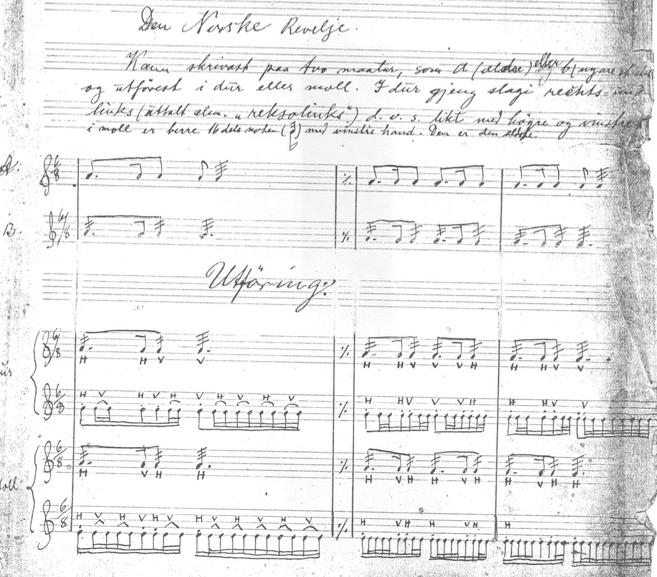
Another Nordic interpretation that supports this idea of implied extra roll notes is the Norwegian Trommeslåtter tradition, which is a folk drumming style that was developed by military drummers who brought their drums home after service in the army of Denmark-Norway or Sweden-Norway (depending on the exact political alignment of Norway at the time of their service). The page below is a concise explanation of the concept from Johannes Sundvor in 1937. Using the “Norske Revelje” as an example, he clearly shows all the notes inserted between the same basic rhythm as the Swedish “Reveljslag” above. This was likely not developed independently from the military tradition, but copied directly from it. If you look at the 4th line of notation down from the top, the “Dur,” or major version, the rhythm corresponds almost exactly to the French and Swiss pattern. The “Moll,” or minor, version at the bottom inserts even more roll notes between the written strokes, stretching the pattern out further, making it sound more like the Prussian “Reveille” or the later German Empire’s “Wecken,” which were essentially the same signal. These will be discussed below.
I do not believe the Nordic countries are alone in this implied interpretation. The Prussian Winters-Wittwe book from 1777 gives nearly the same music for the “Reveille” as the Swedish and Norwegian examples above. The notable difference is the presence of either double stops or flams in the notation (I think they are double stops, but its irrelevant here which they are). This would be more difficult to execute with the above roll structure, but not impossible by any means.
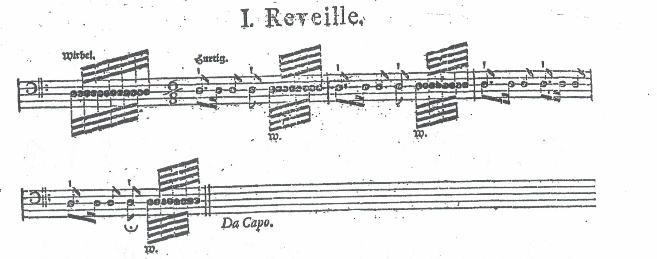
The same signal appears in 1809 in the Netherlands in Over Het Tromslaan as “De Reveille”and looks almost like a direct copy of the Prussian signal.
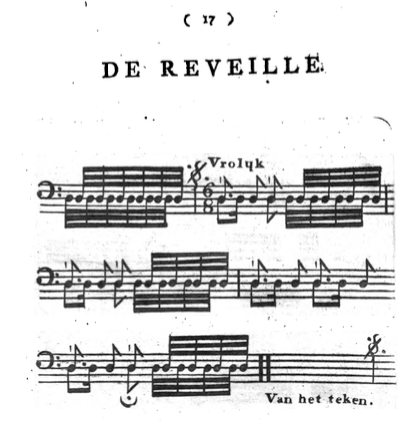
A slight variation on this idea appears in the 1815 Dutch work of Rauscher, who sees fit to actually include slightly more of the roll pattern in the notation. If played precisely as notated it would be slightly less rolling than the French and Swiss, but I believe it is intended to at least approximate the sound of the “Tagwacht” while conforming more to an actual 6/8 feel. This is essentially the Norwegian “Moll” version of the “Revelje” with just slightly fewer roll notes.
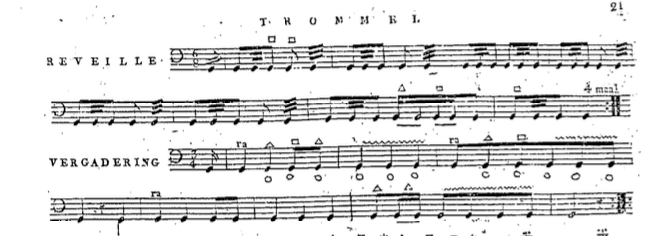
By 1847, the Prussians had also revised their “Reveille,” which corresponds pretty well to the 1815 version of the Dutch “Reveille.” There is a very large gap in the Prussian written record, so it is very hard to say whether the Prussians copied the 1815 Dutch signal, or whether the Dutch copied the Prussians sometime between 1777 and 1815. Either way, they came out about the same. This would later be called “Wecken” in Prussia and the German Empire after the 1880s.
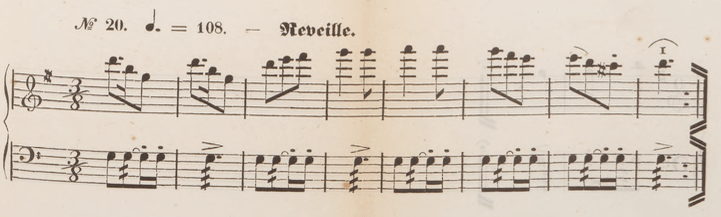
Spain’s 1761 “La Diana,” below, used a very similar rhythm to the Prussians, Dutch, Swedes, and Norwegians. There is no specific evidence that they inserted extra roll notes in between the written rhythms, but they may have if they followed the same performance practices as other European nations.

While its impossible to prove with absolute certainty that every group of drummers throughout history interpreted these Reveille signals in the same way, the Nordic countries, French, and Swiss all align very neatly and the notation bears striking resemblance to that of the Prussian, Spanish, and Dutch Reveilles. Rauscher’s notation (repeated in later Dutch manuals and Prussian manuals) hints at more rolls than most of the others, lending credibility to the idea that, at least in the Netherlands and Prussia, a more densely rolled signal was used as well, even if it was not the exact “Tagwacht” rhythm. None of these European signals sounds precisely like the “Three Camps,” but the conceptual basis of a series of accents filled in with continuous rolling is quite similar and points toward some shared ancient origin. If any of the Reveille signals was somehow not played with the continuous roll, I contend that it is because the roll was lost over time, not because the other countries all somehow gained the roll independently from a non-rolled origin.
To further throw controversy at the issue, I believe that many of these signals roughly correspond to a rhythmic framework of quintuplets as in the 1981 Swiss and the 2024 Swedish notation. The Swiss “Tagwacht” and French “Diane” both trend toward an interpretation of an even quintuplet, where all the rolls are “averaged out”across the measure. One might call this the “Basel Swing” in Switzerland today, where the rhythm is idiosyncratic and does not conform to triplets or 16ths. Sundvor actually made recordings of this type of beating in the 1930s, so we can hear that his time tends toward that “averaged out” rhythm as well. Many, many versions of “Three Camps” are written with 8th notes or dotted 8ths and 16th notes, though we all now agree that the rhythm is triplets or 6/8. Terribly inaccurate notation for this type of signal was extremely common in the British and American traditions, so it logically holds that this could be the case in Europe as well.
More work will need to be done on this idea, but it is my assertion that Reveille signals across the rudimental world conform to a conceptual format of repeated accents among a texture of continuous open rolls, despite what the notation may or may not look like. These fall roughly into three rhythmic patterns: the “Three Camps,” used in the British Empire and USA; the “Tagwacht” or “Diane,” used in Switzerland, France, Spain, Denmark, Norway, Sweden, Prussia (earlier) and the Netherlands (earlier); and the “Wecken,” used in Prussia (later), the German Empire, The Netherlands (later), and Norway (later).
My recommendation is — when in doubt, roll the Reveille; and when not in doubt, roll the Reveille anyway.
**side note: there are occasionally beatings written in American manuals from the late 19th century simply named “Reveille” that are not part of this discussion. These are separate beatings that were written to accompany the bugle signal, not the fife tunes of the traditional reveille sequence. They often do not conform to a continuous roll structure because they are not really connected to the ancient fife and drum practices.

